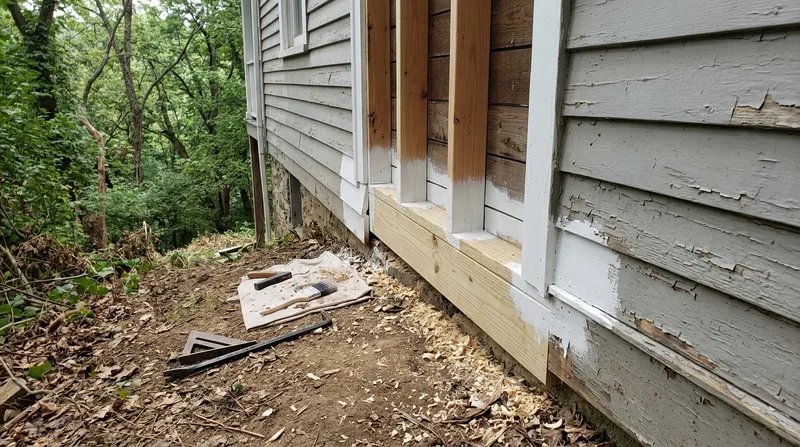




Wood rot and dry rot repair in Cincinnati is a year-round necessity for homeowners navigating the city's freeze-thaw winters, humid summers, and steep hillside terrain. Cincinnati's brick bungalows, Italianate rowhouses in Over-the-Rhine, and post-war ranch homes across the East and West sides all face the same moisture-driven wood decay that comes with four seasons of weather cycling through wood framing, siding, trim, and structural members. The freeze-thaw cycle is relentless: water enters wood in fall and winter, ice expands it, thaw releases it, and the cycle repeats until the wood loses its structural integrity. We cut out decayed framing, siding and trim, treat surrounding wood, and rebuild with rot-resistant lumber, a permanent repair, not a cosmetic patch. Our work covers floor joists, rim joists, sill plates, fascia, soffit, window casings, door jambs, and load-bearing studs in homes across Cincinnati, Blue Ash, Montgomery, Mason, West Chester, and the surrounding counties.
Why Wood Rot and Dry Rot Repair Matters in Cincinnati's Climate
Cincinnati sits in a humid continental climate with cold, snowy winters and warm, moisture-laden summers. The city's topography, with its famous seven hills and steep ravines, concentrates water runoff and keeps foundations and lower wood members saturated longer than flatter regions. Brick veneer on wood-frame homes traps moisture against the framing. Older homes in Clifton, Price Hill, Mount Adams, and Hyde Park were built without modern vapor barriers, making them particularly vulnerable. Once wood begins to soften and lose its grain structure, decay accelerates, and the structural integrity of floor systems, wall frames, and exterior trim deteriorates rapidly.
- Freeze-thaw cycles force water deep into wood, breaking down cell structure and creating pathways for fungal colonization.
- Humid summer months and moderate termite pressure in the Ohio River valley create ideal conditions for both wet rot and dry rot to establish in wall cavities and joist spaces.
- Brick veneer and dense landscaping on hillside lots trap moisture against wood siding and framing, accelerating decay in areas that never fully dry.
- Older homes without modern drainage or vapor barriers suffer accelerated decay in basement rim joists, band boards, and crawlspace framing.
- Delayed repair of small rot pockets in trim or fascia allows decay to migrate into load-bearing members, turning a trim job into a structural one.
Early detection and repair of wood rot prevents structural failure and keeps repair costs proportional to the damage, not compounded by years of neglect.
Key info: Cincinnati's winter moisture and spring thaw create peak wood rot activity in late winter and early spring. Homeowners in Over-the-Rhine, Mount Adams, and Walnut Hills often discover rot in fascia, soffit, and window casings once snow melts and exterior wood dries enough to reveal the damage. Addressing it before the next freeze cycle prevents expansion into framing and foundation sill plates.
For more information on related structural issues, see our page on floor joist and subfloor repair in Cincinnati, which often uncovers rot in rim joists and band boards during investigation.
For detailed guidance on permits and inspections, homeowners can consult the Cincinnati Building Services division, which oversees residential repair permits in the city.
How We Repair Wood Rot: Our Process in Cincinnati Homes
Our approach to wood rot repair is structural, not cosmetic. We begin with a thorough inspection of the affected area and surrounding wood, probing to determine the depth and extent of decay. Once we identify all compromised wood, we cut it out completely, treating the surrounding sound wood with a wood preservative to arrest any incipient decay. We then rebuild the damaged section with rot-resistant lumber, typically pressure-treated Douglas fir or redwood, depending on the application and local availability. The repair is sized and fastened to carry the same load and function as the original member. This approach works on fascia, soffit, window casings, door jambs, floor joists, rim joists, sill plates, and exterior trim throughout Cincinnati and the surrounding service area.
- We probe the wood with a sharp tool to identify the full extent of decay, not just the visible soft spot.
- We cut out all decayed wood, extending the cut into sound wood to eliminate any compromised grain.
- We treat exposed sound wood with a wood preservative to arrest any fungal activity at the cut edges.
- We install new rot-resistant lumber, fastened securely and sealed to prevent future moisture intrusion.
- For structural members such as floor joists or rim joists, we may sister new lumber alongside the existing member or replace the section entirely, depending on the extent of damage and load requirements.
- We finish exterior repairs with paint or stain to match the original, protecting the new wood from future moisture exposure.
The repair is permanent because we remove the cause (moisture and decay) and rebuild with material that resists it, not because we apply a coating or filler.
Local example: A brick bungalow in Hyde Park with rot in the soffit and fascia along the roofline typically requires removal of 2 to 4 feet of damaged soffit, treatment of the underlying rim joist and band board, and installation of new pressure-treated fascia and soffit, all sealed and painted. The same home may have a rotted window casing in a bedroom; that casing is cut out and rebuilt in place, with the window frame protected and the new wood sealed and caulked. Both repairs use the same method: remove decay, treat sound wood, rebuild with rot-resistant material.
For complex structural repairs involving floor joists or load-bearing studs, see our page on framing and structural carpentry in Cincinnati.
| Repair Approach | Description | Best For |
|---|---|---|
| Localized Cut-and-Replace | Remove decayed section, treat sound wood, install new rot-resistant lumber in same location. | Fascia, soffit, window casings, door jambs, exterior trim, and small sections of rim joist. |
| Sistering | Install new rot-resistant lumber alongside compromised member, fastened securely to carry load jointly. | Floor joists, rim joists, and sill plates where full replacement is difficult or where partial decay allows the original member to retain some capacity. |
| Full Member Replacement | Remove entire compromised member and install new rot-resistant lumber, sized and fastened to code. | Floor joists, rim joists, sill plates, and structural studs where decay is extensive or load-bearing capacity is critical. |
| Preservative Treatment | Apply wood preservative to sound wood surrounding the repair area to arrest incipient decay and prevent fungal spread. | All repairs, applied to cut edges and surrounding wood to ensure no decay colonizes the repair boundary. |
Wood Rot and Dry Rot Repair Cost in Cincinnati: What to Expect
Wood rot repair costs in Cincinnati typically start at $650 for small, localized damage to exterior trim, fascia, or a single window casing. Larger repairs involving multiple sections of soffit and fascia, or damage to rim joists and band boards, generally range from $1,200 to $3,500 depending on the extent of decay, access to the damaged area, and the structural member involved. Repairs to floor joists, sill plates, or load-bearing studs can exceed $5,000 if sistering or full replacement is required. The primary factors that affect cost are the size of the damaged area, the accessibility of the wood (fascia is easier to access than a joist in a crawlspace), the species and type of replacement lumber needed, and whether the repair is purely cosmetic or load-bearing.
We recommend getting two or three estimates from local carpenters before committing to a repair. This allows you to compare the scope of work, the materials proposed, and the timeline. Some contractors may recommend full replacement where repair is sufficient; others may underestimate the extent of decay. A detailed estimate should specify what wood will be removed, what preservative treatment will be applied, and what new lumber will be installed, along with the finish (paint, stain, or sealant).
For a detailed pricing overview covering all our services, visit our pricing page. To schedule a free, no-obligation estimate, call us at (513) 822-4039 or contact us online.
What to Look for When Hiring a Carpentry Contractor Near Me in Cincinnati
When selecting a carpenter for wood rot repair near Cincinnati, verify that the contractor is fully insured and carries general liability and workers compensation coverage. Ask for references from recent jobs in your neighborhood, whether Over-the-Rhine, Mount Adams, Hyde Park, or the suburbs. Request a detailed written estimate that specifies the scope of work, materials, timeline, and finish. For any repair involving structural members such as floor joists or load-bearing walls, confirm that the contractor understands local permit requirements and will work with the Cincinnati Building Services division to obtain necessary approvals before work begins. If your home is in a historic district or subject to homeowners association guidelines, verify that the contractor is familiar with those restrictions and that the proposed repair meets them.
- Confirm that the contractor is fully insured with current general liability and workers compensation coverage, and request a certificate of insurance.
- Ask for at least three references from recent repairs in Cincinnati or the surrounding suburbs, and call them to discuss the quality of work and adherence to timeline.
- Obtain a detailed written estimate that breaks down materials, labor, and finish work, so you understand exactly what you are paying for.
- Verify that the contractor understands local permit requirements for structural repairs and is willing to work with the building department if needed.
- If your home is in a historic preservation district or subject to HOA restrictions, confirm that the contractor has experience meeting those guidelines.
- Ask about the contractor's warranty on the repair work and what it covers.
A reputable local carpenter will answer these questions clearly and provide references without hesitation. If a contractor rushes the estimate, avoids written agreements, or cannot provide references, consider other options.
For more guidance on finding a trustworthy contractor, reach out to us for a free estimate, or call (513) 822-4039 to discuss your specific repair and timeline.
Wood Rot & Dry Rot Repair in Cincinnati: Pricing Guide
| Service | Price | Details |
|---|---|---|
| Fascia, soffit, or trim repair | Starting at $650 | Localized cut-and-replace of rotted fascia, soffit, or window casing, including treatment and finish paint or stain. |
| Multi-section soffit and fascia | Starting at $1,200 | Repair of 4 to 8 feet of soffit and fascia along roofline, including rim joist inspection and treatment of underlying band board. |
| Floor joist or rim joist repair | Starting at $1,800 | Sistering or partial replacement of compromised floor joist or rim joist, including treatment of adjacent framing and subfloor protection. |
| Sill plate or structural stud repair | On estimate | Full assessment and repair of load-bearing sill plates or studs requires on-site inspection to determine sistering versus replacement and load capacity. |
| Travel | Included | No separate mileage or travel fee within Cincinnati and surrounding service area counties. |
| Free estimate | No charge | Response within 24 hours at (513) 822-4039, includes site inspection and detailed written proposal with no obligation to book. |
Indicative pricing, the exact cost depends on square footage, finish, and site access. Free personalized estimate within 24h at (513) 822-4039.


